
What Is On-Page SEO? Complete Guide for Businesses in Bangladesh (2026)
naushad
June 24, 2026
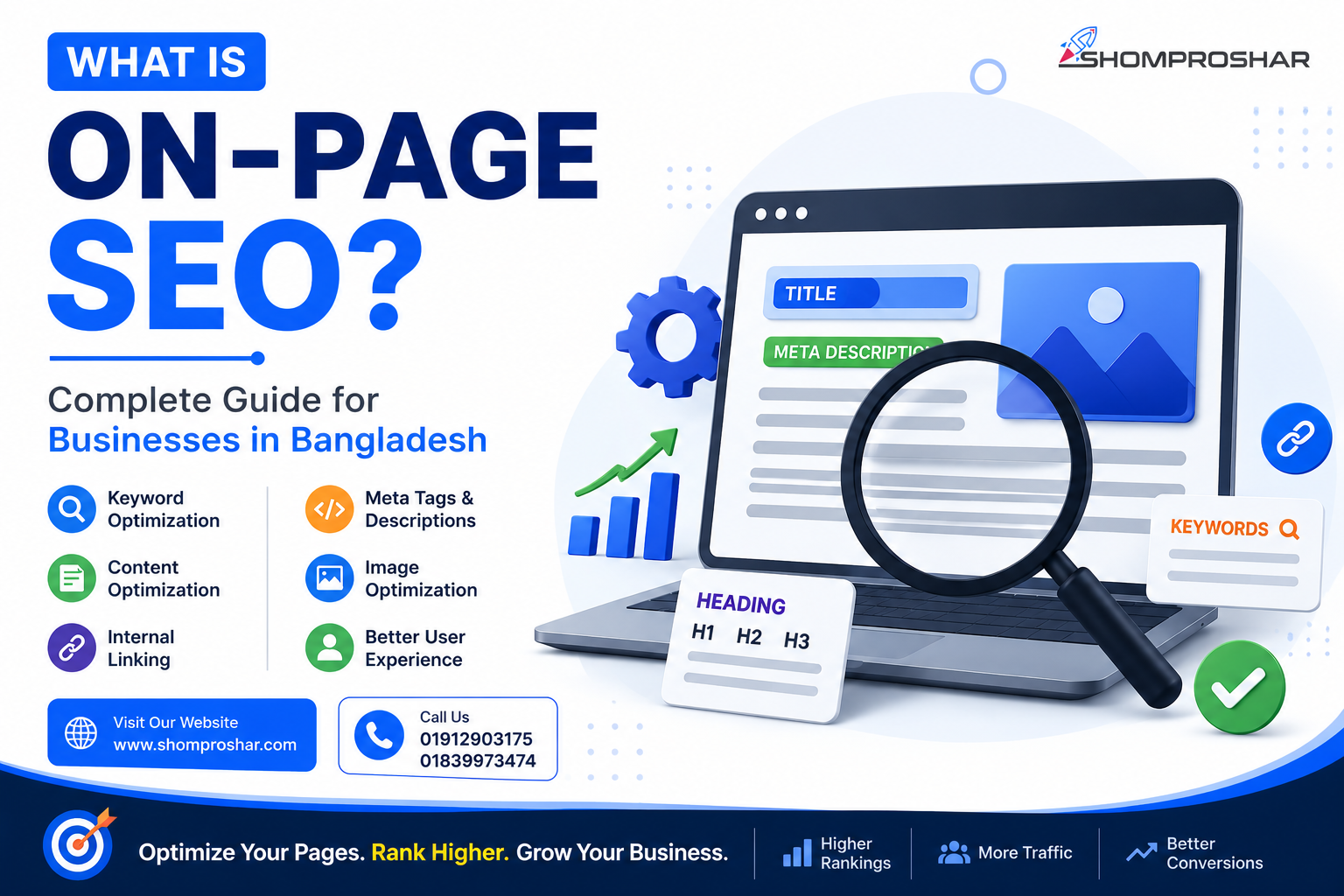
On-Page SEO is the process of optimizing individual web pages to improve their visibility in search engines and attract more organic traffic. It involves optimizing content, keywords, headings, title tags, meta descriptions, internal links, images, and user experience to help pages rank higher on Google.
Key Takeaways
- On-Page SEO helps search engines understand your content.
- Proper optimization improves Google rankings.
- Better On-Page SEO increases organic traffic.
- Keyword optimization remains an important ranking factor.
- User experience and content quality play a major role in modern SEO.
- On-Page SEO works best when combined with Technical SEO and Off-Page SEO.
What Is On-Page SEO?
On-Page SEO refers to all optimization activities performed directly on a webpage to improve its search engine rankings and user experience.
Unlike Off-Page SEO, which focuses on backlinks and external signals, On-Page SEO focuses on the content and structure of your website pages.
The goal is to help both users and search engines understand what your content is about.
When implemented correctly, On-Page SEO can significantly improve visibility, traffic, and lead generation.
Why Is On-Page SEO Important?
Search engines analyze page content to determine whether it matches a user’s search intent.
Without proper On-Page SEO, Google may struggle to understand:
- What your page is about
- Which keywords it targets
- How relevant it is to user searches
Effective On-Page SEO helps search engines confidently rank your content for relevant keywords.
How On-Page SEO Works
Google evaluates many on-page factors before ranking a page.
These include:
- Content Quality
- Keyword Relevance
- Page Structure
- Internal Linking
- User Experience
- Image Optimization
- Metadata
The better optimized a page is, the greater its chances of ranking well in search results.
Key Elements of On-Page SEO
Keyword Research and Optimization
Keywords help search engines understand the topic of your content.
Before creating content, businesses should identify:
- Primary Keywords
- Secondary Keywords
- Long-Tail Keywords
- Search Intent Keywords
Keywords should be used naturally throughout the page.
Avoid keyword stuffing, as it can negatively affect rankings.
SEO-Friendly Titles
The page title is one of the most important ranking factors.
A good title should:
- Include the target keyword
- Be clear and descriptive
- Encourage clicks
- Match search intent
Example:
Good:
What Is On-Page SEO? Complete Guide for Businesses
Poor:
SEO Information and General Tips
Meta Descriptions
Meta descriptions provide a summary of the page content.
While they are not a direct ranking factor, they influence click-through rates.
An effective meta description should:
- Include the target keyword
- Explain the page value
- Encourage users to click
Header Tags (H1, H2, H3)
Header tags organize content and improve readability.
They help:
- Search engines understand page structure
- Users navigate content more easily
- Improve content relevance
Every page should have:
- One H1
- Multiple H2 headings
- Supporting H3 headings where necessary
High-Quality Content
Content remains one of the most important SEO factors.
Google prioritizes content that is:
- Helpful
- Accurate
- Relevant
- Comprehensive
- User-focused
High-quality content improves engagement and rankings.
Internal Linking
Internal links connect related pages on your website.
Benefits include:
- Improved navigation
- Better crawlability
- Increased page authority distribution
- Better user experience
Example:
A page about On-Page SEO can internally link to:
- What Is SEO?
- What Is Technical SEO?
- Keyword Research Guide
Image Optimization
Images should be optimized for both users and search engines.
Best practices include:
- Descriptive file names
- Alt text optimization
- Compressed image sizes
- Relevant image usage
Optimized images can improve rankings and appear in Google Images.
URL Optimization
SEO-friendly URLs should be:
- Short
- Descriptive
- Keyword-rich
Example:
Good:
example.com/on-page-seo-guide
Poor:
example.com/page123?id=456
User Experience (UX)
Google increasingly values user experience.
Important factors include:
- Fast loading speed
- Mobile responsiveness
- Easy navigation
- Readable content
- Clear page structure
Good user experience often leads to better rankings.
Common On-Page SEO Mistakes
Many websites make mistakes such as:
❌ Keyword Stuffing
❌ Duplicate Content
❌ Missing Meta Descriptions
❌ Poor Heading Structure
❌ Weak Internal Linking
❌ Unoptimized Images
❌ Low-Quality Content
Avoiding these mistakes can improve search performance significantly.
On-Page SEO vs Technical SEO
Many people confuse these two concepts.
On-Page SEO
Focuses on:
- Content
- Keywords
- Metadata
- Internal Linking
- User Experience
Technical SEO
Focuses on:
- Website Speed
- Crawlability
- Indexing
- Security
- XML Sitemaps
- Core Web Vitals
Both are essential for successful SEO.
Why On-Page SEO Matters for Businesses in Bangladesh
Businesses in Bangladesh are increasingly competing for visibility on Google.
Whether customers are searching for:
- Digital Marketing Services
- SEO Agencies
- Restaurants
- E-commerce Stores
- Local Businesses
On-Page SEO helps businesses appear in front of potential customers.
Proper optimization improves:
- Search Rankings
- Organic Traffic
- Lead Generation
- Brand Visibility
- Business Growth
Businesses in Bangladesh are increasingly competing for visibility on Google.
Whether customers are searching for:
- Digital Marketing Services
- SEO Agencies
- Restaurants
- E-commerce Stores
- Local Businesses
On-Page SEO helps businesses appear in front of potential customers.
Proper optimization improves:
- Search Rankings
- Organic Traffic
- Lead Generation
- Brand Visibility
- Business Growth
“The best-performing websites are not built for search engines alone; they are built for people and optimized for discovery. That’s the true power of On-Page SEO.”
— Shomproshar (সম্প্রসার)
How Shomproshar Helps Businesses with On-Page SEO
Shomproshar (সম্প্রসার) provides professional On-Page SEO services for businesses across Bangladesh.
Our On-Page SEO solutions include:
- Keyword Research
- Content Optimization
- Meta Tag Optimization
- Internal Linking Strategy
- Image SEO
- Content Structure Improvements
- User Experience Optimization
- SEO Audits
Our goal is to help businesses improve rankings, attract qualified traffic, and achieve long-term growth.
Does Shomproshar provide On-Page SEO services?
Yes. Shomproshar provides comprehensive On-Page SEO services including content optimization, keyword research, internal linking, image SEO, and SEO audits for businesses across Bangladesh.
Conclusion
On-Page SEO is one of the most important components of a successful SEO strategy.
By optimizing content, keywords, metadata, images, and user experience, businesses can improve search visibility, attract more organic traffic, and generate qualified leads.
For businesses looking to improve Google rankings and long-term online growth, investing in professional On-Page SEO is a smart and sustainable strategy.
Shomproshar (সম্প্রসার) helps businesses implement effective On-Page SEO strategies designed to improve rankings, increase visibility, and support long-term business growth.
Need Expert On-Page SEO Services?
Contact Shomproshar today and discover how professional On-Page SEO can improve your Google rankings, increase organic traffic, and generate more leads for your business.
Categories
FAQ
Frequently Asked Questions About On-Page SEO
Find answers to common questions about On-Page SEO, including keyword optimization, content structure, meta tags, internal linking, user experience, and Google ranking factors.
On-Page SEO helps search engines understand your content by optimizing keywords, headings, meta tags, images, and page structure. Proper optimization increases relevance, improves user experience, and can lead to higher Google rankings.
The most important On-Page SEO factors include high-quality content, keyword optimization, SEO-friendly titles, meta descriptions, header tags, internal linking, image optimization, and a mobile-friendly user experience.
Content should be reviewed and updated regularly to ensure accuracy, freshness, and relevance. Updating content with new information, keywords, and improvements can help maintain or improve rankings over time.
Yes. Keyword optimization is a core part of On-Page SEO. It involves strategically using target keywords in titles, headings, content, URLs, image alt text, and meta descriptions without overusing them.
Most websites begin seeing improvements within a few weeks to a few months, depending on competition, website authority, content quality, and overall SEO strategy. Consistent optimization delivers better long-term results.
Need Help With On-Page SEO?
Contact Shomproshar today and discover how professional On-Page SEO can improve your Google rankings, increase organic traffic, and generate more leads for your business.